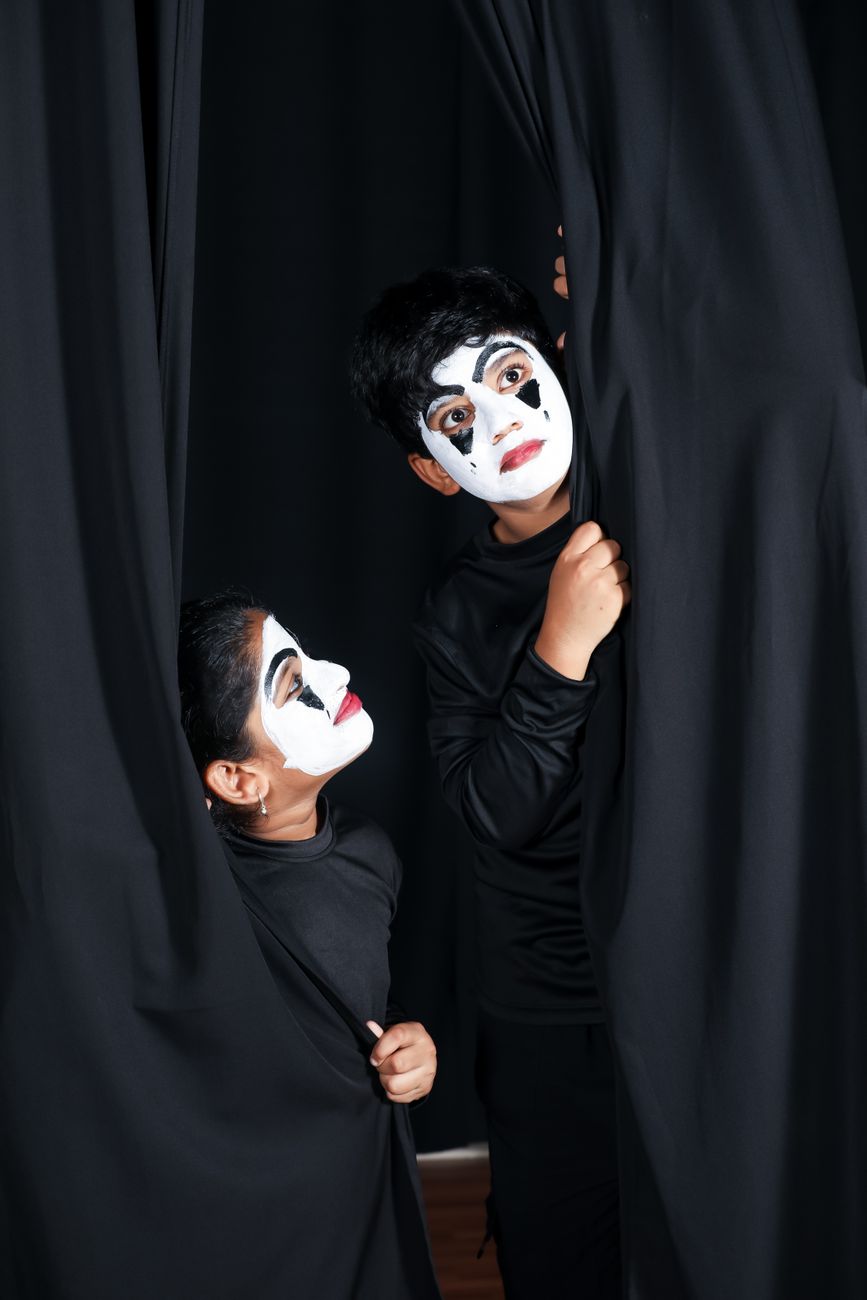
Something I have learned through my involvement in dramatic arts at various schools is that you cannot predict which children will be good on stage on the basis of how they behave in class. I have seen a boy whose public speaking skills earned him a place at the Junior United Nations Assembly freeze in an audition. I have seen a boy whose stuttering was so debilitating that he could barely complete a sentence in the classroom give mesmerising performances in emotionally complex parts. I have seen, more times than I can recount, quiet girls who avoided interaction in the classroom command the stage.
And if I am honest, I am not so different. I find people draining. I detest small talk, and I will do almost anything to avoid a phone call. But I love the stage. When I am teaching, whether teenagers, school principals, or a room of doctors and professors, I have no fear at all.
Which one is the real me? The one who stands at the edge of a party hoping not to be noticed, or the one who relishes the chance to share what he knows? I have no doubt you have had similar experiences. Perhaps you have wondered which is the real you.
I used to think that I was being disingenuous in some way, sometimes hiding parts of myself, sometimes pretending to be who I was not. But I know now that I simply misunderstood the nature of selfhood. I assumed that the contradiction existed because there was a complete, pre-existing self behind these manifestations of me.
But research on the relational self suggests that the self that emerges in any given context is not a hidden core being revealed. It is constituted by that context. Our self-conceptions are linked to our representations of significant others, and those representations can be activated by the people and situations we encounter. There is no pre-existing self that the relationship simply colours in. The relationship is part of what makes the self possible at all.
This is where René Girard becomes useful, in helping us to identify the mechanism by which the biological and the cultural are braided together in the formation of individual human identity. The capacity for imitation is an evolved adaptation. It is what allows human children to acquire skills and knowledge that no individual could reinvent alone. But imitation does not stop at behaviour. What the child imitates is not just what the model does but what the model wants. Desire becomes the structuring dynamic of social learning: it is what draws the child into the model’s world and the force that shapes the child’s cognitive and affective architecture in the image of the model.
What Girard calls the “romantic illusion” is the belief that the self is an autonomous source of its own wanting, the conviction that our desires originate in us, rather than being borrowed from a model whose desire we have absorbed without knowing it. The self is what Girard calls interdividual: a node in relations of imitation and desire, such that the relation is prior to the terms it relates.
Jean-Luc Nancy pushes this further, into ontology. His claim is not merely that selves are shaped by relationships but that existence itself is always coexistence, that there is no being without being-with. The “I” does not precede the relationship. Rather, it is constituted in and as exposure to others. The self is always already outside itself, spaced out among others, never fully present to itself. What I call “me” is a spacing, a relation, a being-toward rather than a thing that is. In other words, the self is not a sealed room that opens its doors to other people. Instead, the very things that allow us to feel any sense of self develop through interaction with a world already inhabited by others.
You do not need to accept every detail of either thinker to see the convergence. Modern psychology says the self is relationally activated. Girard says the self is constituted by borrowed desire and misrecognised as autonomous. Nancy says existence is coexistence. We have three different vocabularies and theories, but they all illuminate one truth: the autonomous self is a retrospective construction generated by a system that cannot see its own dependencies.
It was this evidence that, a decade ago now, finally compelled me to reject so much of the traditional Protestant theology I inherited. Its account of sin, responsibility and salvation seemed to depend on a picture of the individual as a self-contained moral agent, independently responsible for its thoughts and actions. But if our desires, identities and capacities are formed through relationships we neither chose nor fully understand, that picture becomes much harder to sustain. We remain responsible for what we do, but responsibility can no longer be understood simply as the private burden of an isolated individual. That is simply not who we are. “No man,” as Donne so insightfully observed, “is an island”.
And this is what makes the question of death so strange. If the self is constituted through relations of imitation and desire that are largely unconscious and misrecognised, then when someone dies, the relational configuration that constituted a part of you is altered and you may not even know which part, because you never knew it was there. The “I” that dies was never a bounded interior thing. It was a pattern sustained across relationships, so that the death of another person is not simply the loss of an external object. It is the loss of a condition under which a part of one’s own self was possible.
The question of what “I” is (am?) makes thinking about death genuinely difficult. We began this series with the intuition that the self is a pattern, and that death is the cessation of the pattern. But if the pattern is sustained across relations, if part of it lives in the activating presence of others, then the pattern does not simply end when the body ends. It changes. It is redistributed. The version of you that existed in relation to the dead person loses its condition of possibility, and the version that exists in relation to everyone else is altered by the loss.
I have always loved the theatre. I have watched children who seemed almost invisible in the classroom step into the light and become astonishingly present. I have watched others discover, to their own surprise, that the stage does not give them somewhere to hide but somewhere to become.
I used to think they were revealing something that had been there all along, a hidden self finally given permission to emerge. I am no longer so sure. Perhaps the stage makes possible a version of the person that could not have existed in quite the same way anywhere else. The character, the words, the other actors, the audience, the particular moment: none of these is merely the setting in which a pre-existing self performs. Together, they make the performance possible.
And when the curtain falls, something ends. The performance cannot be repeated in precisely the same way. The actors leave the stage, the audience goes home, and the particular configuration of people and possibilities that made that evening what it was is gone. Yet the performance was real. It changed something. Perhaps a child discovered a capacity they had never known they possessed. Perhaps someone in the audience recognised something about themselves. The event has ended, but its ending does not mean that it never happened, or that everything it set in motion has ended with it.
I don’t want to turn this into a comforting metaphor for death. A performance is not a person, and the end of a life is not simply the end of a show. The absence of someone we love is real, and no philosophical account of relationality should make that absence easier to dismiss.
But the theatre has taught me something about the question we began with. There is no need to decide which of my selves is the real one, as though the others were impostors. The person who stands at the edge of the party and the person who commands a room of learners are both real. Neither exists entirely independently of the relationships and circumstances in which that person comes to be.
And that brings me to dad. The loss at the heart of this series. I must be transparent: the assumption I am going to make going forward is that the resurrection of Jesus was a real event. I recognise that it is a contested claim. And in the future we can explore why I feel it is not an unreasonable position to take. But I do not yet wish to be sidetracked by a tangential argument.
What I do want to explore is how to interpret the event, assuming it was real. When I think about the resurrection of Jesus, I find that the fragments we have examined make the traditional picture harder to hold, not easier. If a life is a pattern rather than a thing, what exactly is raised? If death is not an interruption of the life process but an integral part of it, indeed if it is the condition under which new life emerges, then what does it mean to speak of a resurrection that reverses death rather than passing through it? If time is emergent and relative rather than a fixed container, then what sense does it make to speak of a person being restored at a particular moment, in a particular order of events? And if the self is constituted by its relations, then what would it mean to be raised, if the relations that constituted him are not raised with him?
There is a thought I cannot avoid. My father was not a bounded interior thing. He was a pattern sustained across the people who loved him, his reverence for life, his awe at the natural world, the love of knowledge, the terrible jokes, the myriad habits and loves he passed on without knowing it. Some of those relations have already ended. Some have been altered by his death. Some continue in me, in my sisters, in people who never met him but who have been shaped by what he set in motion. If resurrection means the restoration of a person, which configuration will be restored? The one that existed at the moment of his death? The one that existed at his most flourishing? The one that is still being redistributed in the lives of those who survive him?
If the doctrine of resurrection is true, if Jesus was raised from the dead as a pattern of what is to come, then what we conceive of as life after death must be stranger and more wonderful than the picture we usually carry. A resurrection that simply reassembles the atoms and restores the pattern would be a magic trick. A resurrection that gathers a life in all its relations, that raises not just my father but the field of relationships in which he was constituted, is something I can barely imagine.
But he is still gone. And it still hurts.


Leave a Reply