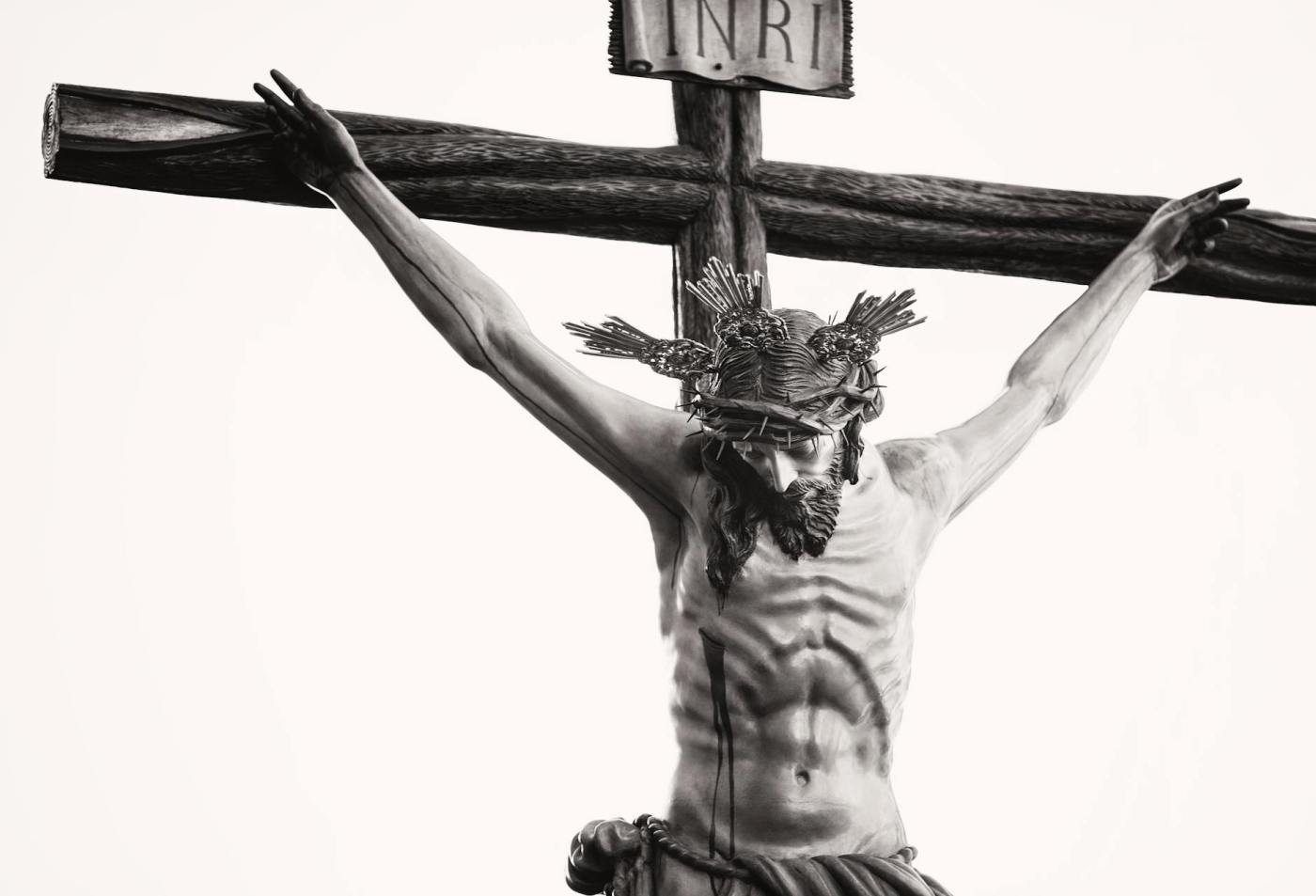
If the Bible isn’t inerrant, if it’s a messy, human text shot through with contradiction and confusion, then what on earth do we do with it? Why bother? I want to stress that my aim in writing these posts has never been to reject the Bible, nor to reject God. Rather, I want to call into question certain ways of reading the Bible and understanding God. A mindset I often encounter is that if the Bible contains errors, then it cannot be trusted, it can contain no truth. But that is certainly not the case. Despite all its flaws – and maybe because of them — it tells a different kind of story. Not a linear one, not an easy one. But a story that, if we’re paying attention, turns the entire human imagination on its head.
At the centre of that story is not a hero, but a victim.
This is not how sacred texts are supposed to work. Mythology is full of victorious gods, warrior kings, chosen people. The divine is with the winners, the powerful, the righteous. That’s how the world has always told its stories: justifying the strong, scapegoating the weak, and naming it holy.
But the Bible, at its deepest, most unsettling level, does something else. It tells the story of humanity through the voice of the one we cast out.
Of course, it doesn’t start that way. Much of Scripture is complicit in the same old game: divine violence legitimating human violence. God destroys. God commands. God blesses this tribe, curses that one. It’s a theology of “God on our side,” written in the blood of enemies. And we read it and nod, because it’s familiar. This is how stories work. This is how power works.
But then something begins to shift. A strange undercurrent runs through the text, barely perceptible at first. The victims start speaking. The blood of Abel cries out for justice. The prophets start protesting. Job rails against divine injustice and gets commended for it. Ecclesiastes looks at the world and calls it meaningless. The Psalms are full of unanswered cries, of abandonment, of longing for a God who doesn’t seem to show up.
And then, impossibly, the victim becomes the centre.
Jesus doesn’t just speak for the excluded. He becomes one of them. More than that, he becomes the one who is excluded by religion, by Scripture, in tge name of God. The law and the prophets, the Temple and the priests, the traditions and the sacred texts, all align to eliminate him.
And he lets them.
This is not a God who demands blood. This is a God who bleeds.
Jesus doesn’t come to vindicate Scripture. He comes to expose it. To show us where we’ve misunderstood, where we’ve used God to justify our violence, where we’ve twisted holiness into exclusion and righteousness into wrath. He stands in the place of the scapegoat, not to fulfil a divine requirement, but to reveal that there never was one.
The cross is not the satisfaction of God’s justice. It is the collapse of our own.
The resurrection is not God saying, “Now I am appeased.” It is God saying, “You were wrong about me.”
This is what makes the Bible worth reading: not because it is perfectly right about God, but because, through all its missteps and contradictions and projections, it ultimately bears witness to the one who is. The one who refuses to be drawn into rivalry. The one who will not repay violence with violence. The one who dies saying, “Father, forgive them”.
That voice, easily drowned out, is the only trustworthy thread in the whole tapestry. The forgiving victim. A better blood than the blood of Abel.
Read the Bible through that lens, and everything changes. Abraham’s near-sacrifice of Isaac becomes a story not about obedience, but about the end of child sacrifice. The Exodus becomes a liberation narrative not because “God” destroys Egypt, but because God hears the cry of the oppressed. The prophets stop sounding like divine mouthpieces and start sounding like truth-tellers, calling Israel back from nationalism and injustice.
Even the most violent texts become sites of revelation not because they show us what God is like, but because they show us what we are like without God.
The difference is subtle but seismic. If you believe every word of Scripture is the voice of God, then you’re left trying to explain the genocides, the stonings, the blood rituals, the tribalism. You end up with a two-faced God, merciful one minute and monstrous the next.
But if Jesus is the Word of God, the only Word, then we can stop pretending that everything the Bible says God said, God actually said. We can finally tell the truth: that much of Scripture is a record of humanity projecting its fears and rivalries onto the heavens, and calling it divine. When Jesus claims that nobody comes to the Father except through him, it is not a mystical invitation to “invite Jesus into your heart”; it is an unmasking of all false images of God. It is a call to let go of every violent, nationalistic, or tribal projection we’ve ever mistaken for the divine. It is not about theological gatekeeping or securing a place in the afterlife, it is about transformation. Jesus is saying: if you want to know the Father, look only at me. Not at the genocidal commands, not at the thunderclouds and temple rituals, not at the God of exclusion, vengeance, and wrath. Only in Jesus, self-giving, nonviolent, forgiving even in death, do we see God unveiled.
This is not a narrow claim; it is a liberating one. It means we are no longer bound to every divine decree that justifies war, domination, or scapegoating. We are invited to know a God who looks like Jesus and nothing else.
The Bible invites us to question it, to argue, to repent not just of our sins, but of our theologies. It dares us to follow the thread of the forgiving victim, even when it leads us away from the familiar and into the wild terrain of grace.
And grace is not comfortable. It’s not easy. It will make you rethink everything you thought you knew about God, about Scripture, about justice. But the way of the cross is a lonely road. I have found that Jeanette Winterson was right in the article she wrote in the Guardian on September 18 2001, in the aftermath of 9/11, calling for forgiveness and self-reflection instead of retaliation: “Make no mistake, plenty of people prefer the world as terror. The world as love is just too hard to take.” Love offends.
But it’s worth it.
Because in the end, the Bible is not about the people who got God right. It’s about a God who shows up anyway. And that is what makes the Bible valuable. It is not precious because every line is the voice of God, but because the story arcs toward this radical disillusionment, this breathtaking revelation, that God is not who we feared. If we let Jesus, the forgiving victim, dismantle our idols, our certainties, our righteous indignation, we can finally be free from the curse of the Law. We can learn to love instead.
 Vapors In The Wind
Too, much of the NT is laced through with OT creeds- the Thunder Sons calling down fire, disciples wondering who sinned, the blind guy or his parents, the vengeful deaths of Ananias and Saphira. I wonder too that the physical resurrection of Lazarus and Jesus- flesh and blood aren’t part of God’s kingdom- our fellowship is in spirit.
LikeLike